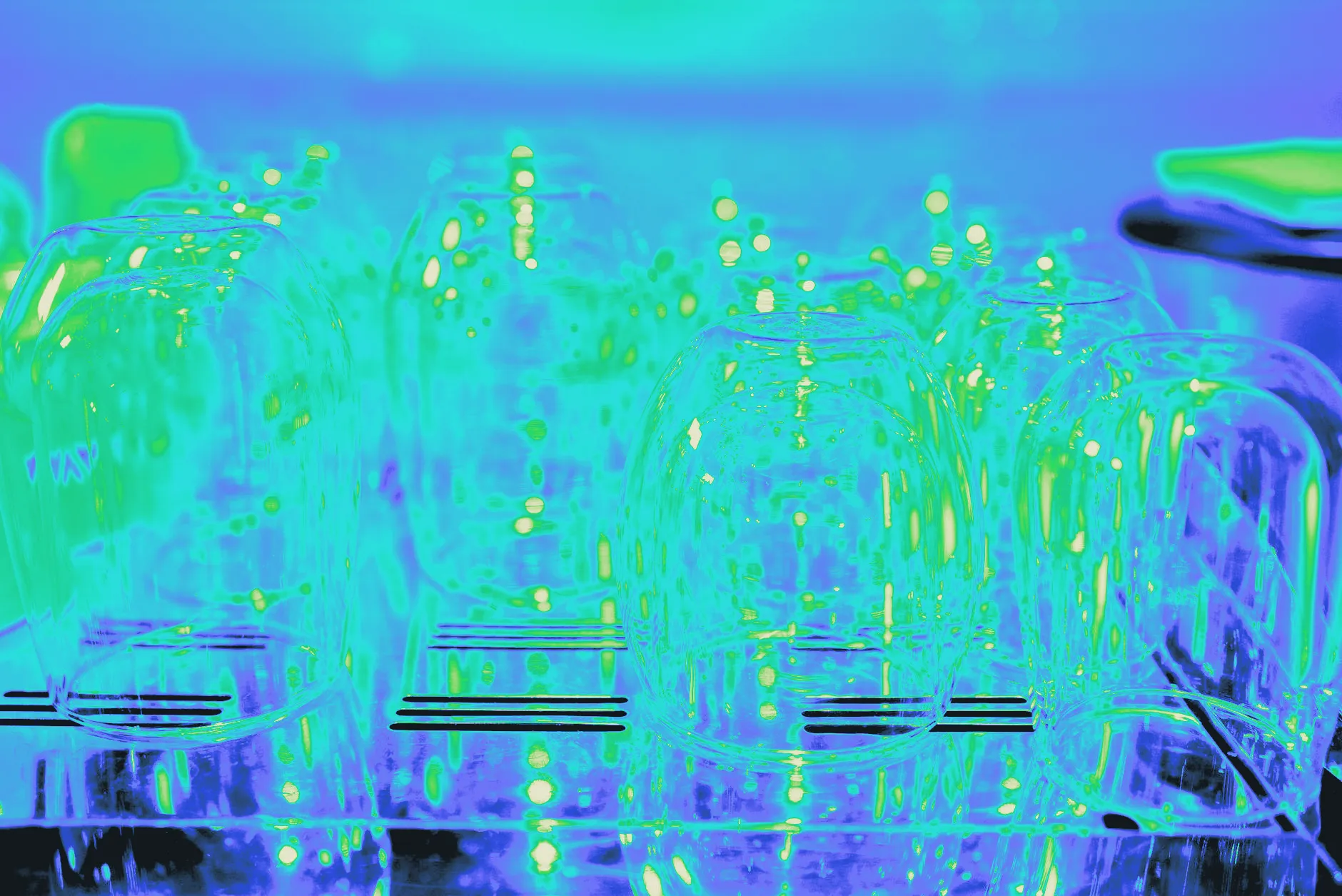
Rinse aid lowers water’s surface tension so it sheets off dishes in a thin layer instead of clinging in beads. Less standing water means less mineral residue left behind once it evaporates, which is what actually prevents spots and cloudy film. Detergent handles cleaning; rinse aid handles what happens to the water afterward.
The signs you’d actually notice
- Spots or a cloudy film on glasses and dark dishware, especially in a hard water area
- Dishes that come out visibly wet rather than mostly dry at the end of the cycle
- A dishwasher with an empty or blinking rinse aid indicator
If none of those show up, your water may already be soft enough, or your detergent already includes a rinse aid component, that skipping it isn’t causing a visible problem.
Why water beading causes spots in the first place
Water on its own has high surface tension, which pulls it into individual beads rather than a flat sheet. Each of those beads sits on the dish through the entire dry cycle, and as it evaporates, whatever minerals were dissolved in it are left behind exactly where the bead was, as a small spot. A thin, even sheet of water evaporates the same way but leaves far less residue per square inch of surface, since there’s less water sitting on any one spot to begin with. Rinse aid is a surfactant, the same category of ingredient that lets detergent lift grease, but its job here is purely about how the water spreads and drains, not about cleaning anything.
What you’re trading off if you skip it
Skipping rinse aid doesn’t affect how clean dishes come out, since that’s detergent’s job. The trade-off is entirely cosmetic and drying-related: more spotting in hard water, and dishes that may still be damp when the cycle ends, since a beaded surface takes longer to air-dry than a sheeted one. Soft water households often don’t notice a difference either way, which is why some dishwashers let you dial the dispensed amount down or off entirely.
Frequently asked questions
- How does rinse aid work?
- It lowers the surface tension of the final rinse water. Water with high surface tension pulls into beads on a dish, and each bead sits there through the dry cycle and leaves its dissolved minerals behind as a spot. With rinse aid the water spreads into a thin sheet and runs off, so less water stays on the dish and less residue is left when it evaporates. It does not clean anything; the detergent still does that.
- Does rinse aid replace detergent?
- No. Detergent does the actual cleaning; rinse aid only changes how water behaves during the final rinse and dry. Running rinse aid alone with no detergent won't clean dishes.
- Can rinse aid damage plastic items?
- Rinse aid itself isn't the concern; it's the heated dry cycle that softens some plastics over repeated washes. If plastic items are warping, switching to an air-dry or lower-heat setting addresses that more directly than skipping rinse aid.
- Is it safe to run every load?
- Yes. Most dishwashers already dispense it automatically in small, metered amounts, so running it every load is the normal, intended use rather than something to ration.